
contact usAsk for a method statement.
Tell us the structure, the water condition and the access you have, and our technical team will write the build-up for your project.


Contacts
Maslak Mh. Ahi Evran Cd. No:21
Polaris Plaza - Floor 26
SARIYER | ISTANBUL / TURKIYE
TR: +90 212 706 97 61
GEO: +49 4921 825 8979
DE: +49 4921 825 8979
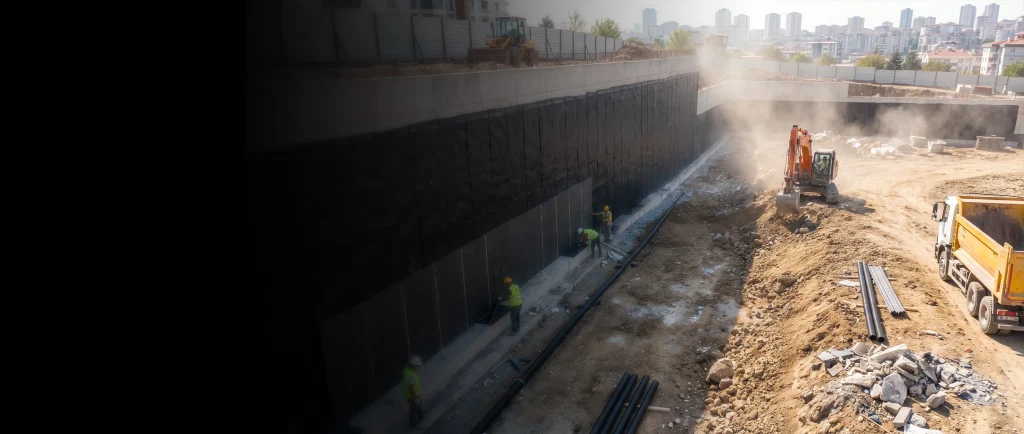
Below ground, water does not arrive and leave. It stands against the structure and the soil pushes it. These systems keep it out of foundations, retaining walls, basements, lift pits and buried decks, from the layer applied before the concrete is poured to the joints where most failures begin.
• A below-grade membrane is covered as soon as it is finished. Backfill goes in, the slab goes down, and that surface is not seen again for the life of the building. When water finds a way through, it appears somewhere inside, often a long way from where it entered, and reaching the entry point means excavating.
• So the decisions are made before the concrete is poured: whether the membrane goes on the blind side or the outer face, whether the structure will carry standing water or damp soil, how the construction joints are treated, and what protects the membrane while the trench is backfilled.
” Most below-grade failures are not membrane failures. They are joints, penetrations, and damage done after the waterproofing was signed off.”
1 · No access to the outer face after the pour →
2 · Accessible outer face, standing water →
3 · Complex geometry, many penetrations →
4 · Damp substrate, tight programme →
5 · Soil and planting over the structure →
6 · Negative side, or waterproofing cast into the concrete →
7 · Load, movement or speed justify the cost →
When it is preferred:
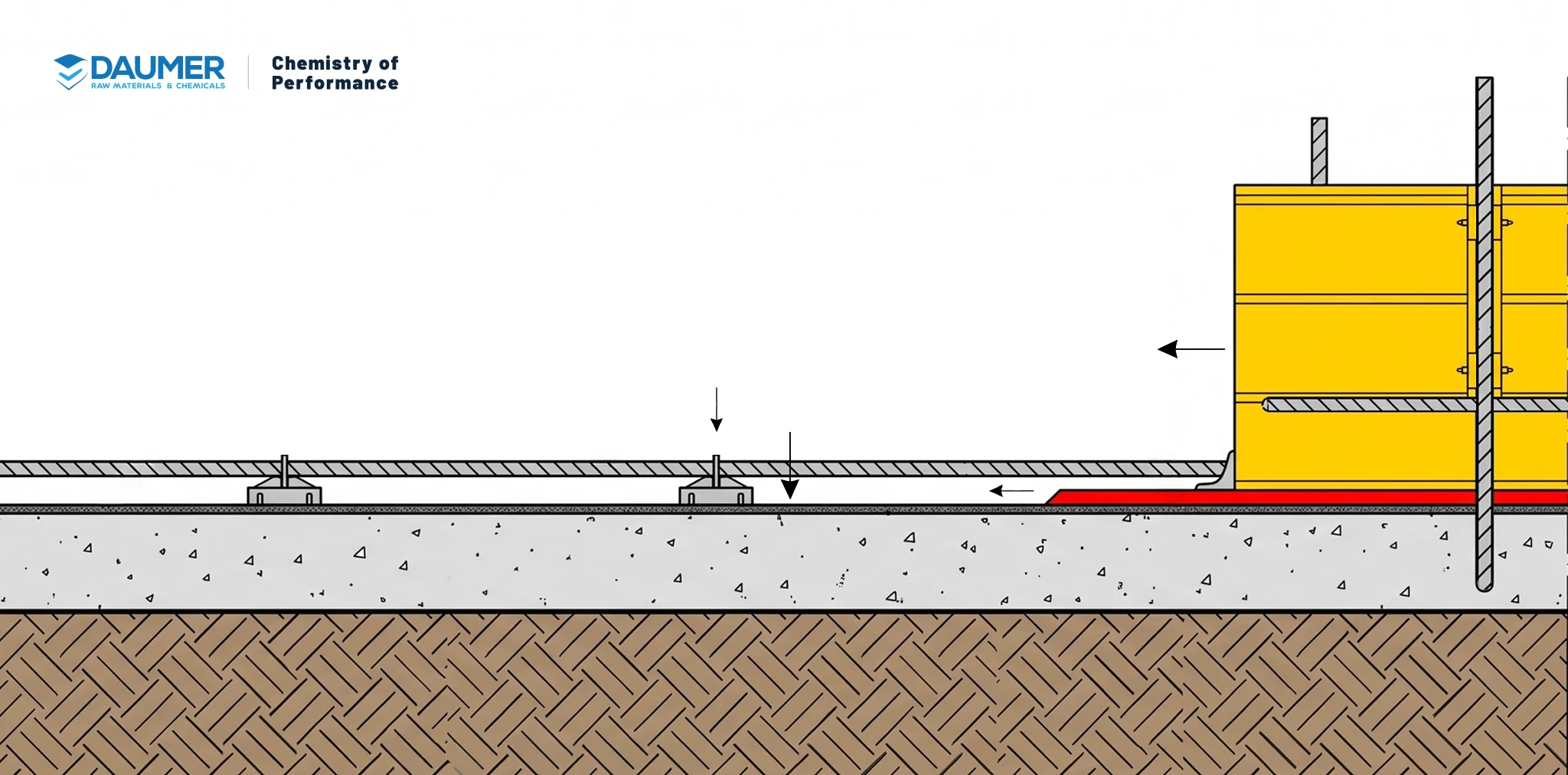
There will be no access to the outer face after the pour. Raft foundations, blind-side retaining walls cast against shoring, lift pits and shored excavations all share the same problem: once the concrete is in, the waterproofing can never be reached again. A pre-applied system solves it by putting the membrane down first and letting the structure bond itself to it.
• Blinding concrete or formwork clean, even and free of protruding material
• Standing water removed; the surface may be damp
• Joint elements set out before laying begins
• Sheet layout planned so that overlaps run with the direction of the pour
The membrane is laid before the reinforcement, with its sand-coated face upward. Fresh concrete is cast directly onto it, and as the concrete hydrates it grips that textured face and forms a bond across the whole area.
That bond is what separates this system from every other one on this page. In an unbonded system, water that gets past the membrane at any single point can travel between membrane and structure until it finds a crack, and the leak then appears far from the breach. Here there is no gap to travel through. A puncture stays a puncture.
• Overlaps checked and sealed before reinforcement is placed
• Membrane protected from site traffic, dropped tools and reinforcement ends
• Damage repaired before the pour, never after
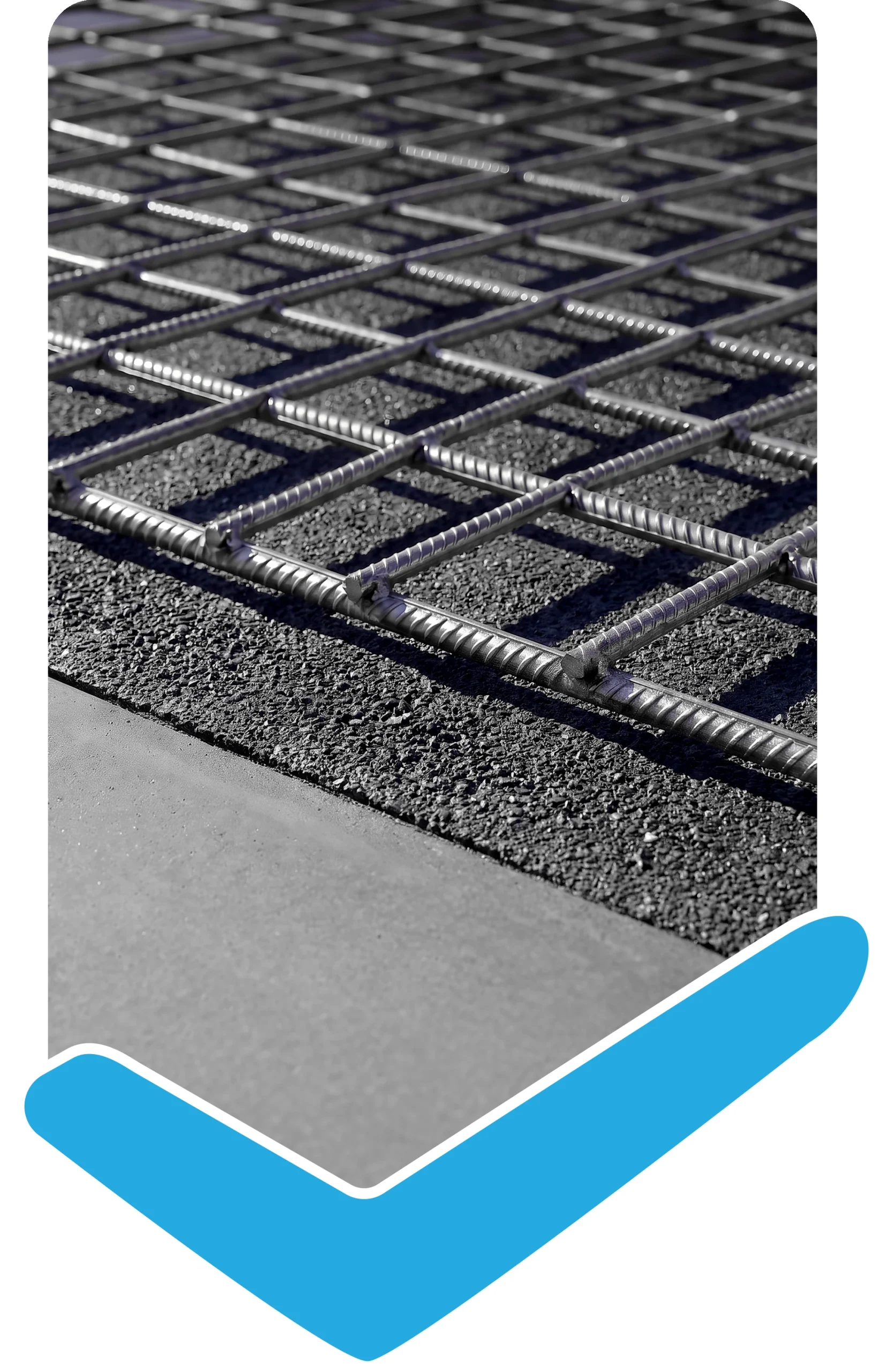
A bonded pre-applied sheet is the only configuration in which a puncture does not become a leak somewhere else. Everything depends on the concrete reaching the membrane, so the pour is part of the waterproofing.
Key outcomes
• Single layer, no hot work on site
• No dependence on future access to the outer face
• Leaks stay where they start, which makes them findable
Products
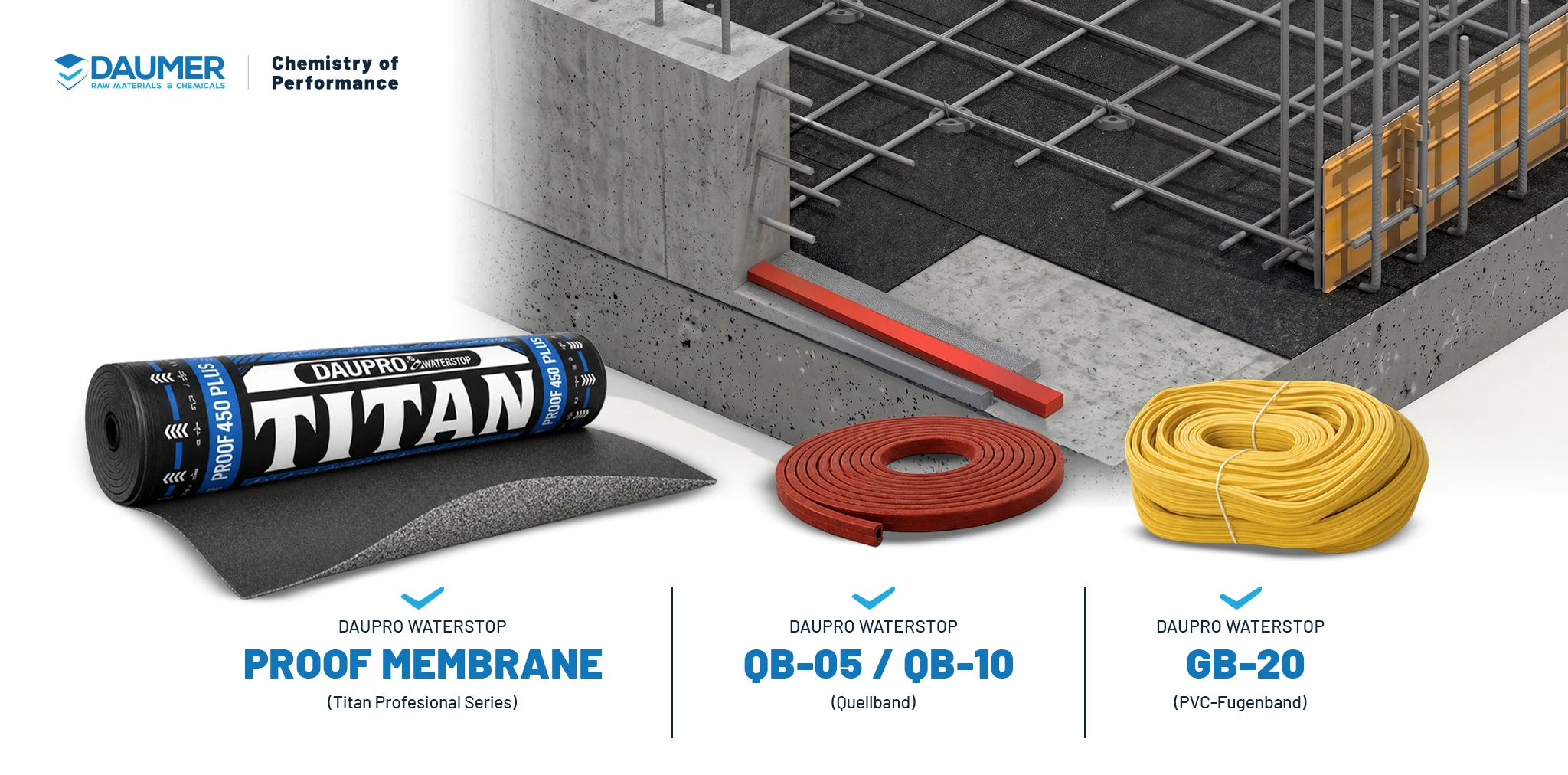
• DAUPRO WATERSTOP PROOF · pre-applied bonded membrane, laid sand face up
• DAUPRO WATERSTOP QB-05 / QB-10 · hydrophilic swelling bar for construction joints
• DAUPRO WATERSTOP GB-20 · PVC waterstop cast into movement joints
Joints and penetrations · Recommended
– Swelling bar along construction joints between pours
– PVC waterstop where a movement joint passes through the structure
– Penetrations sealed before the pour, not after
When it is preferred:
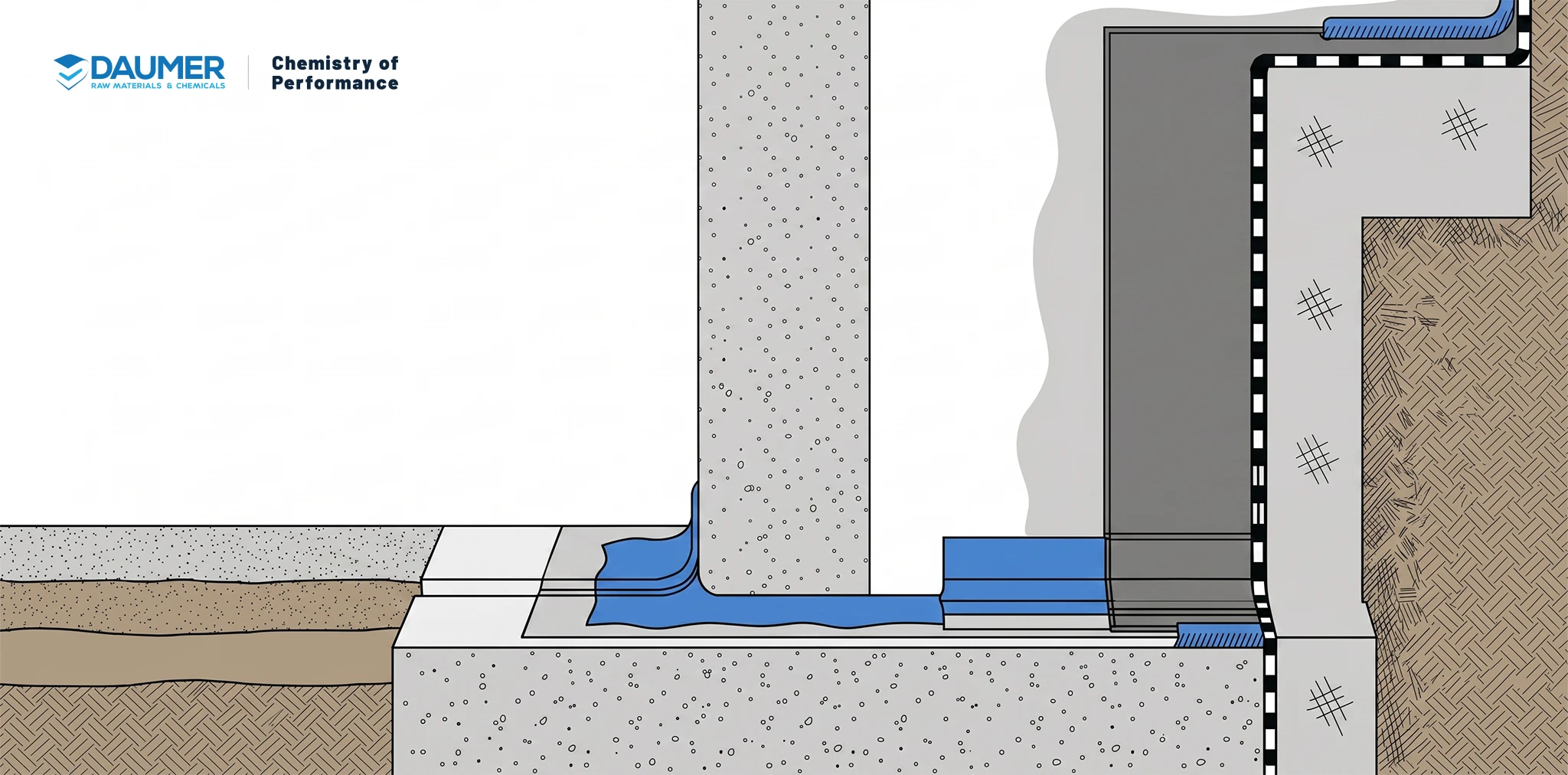
The outer face can be reached after the pour, the structure will face standing water or hydrostatic pressure, and the programme allows a sheet system to be laid and inspected. This is the traditional route for foundations, retaining walls and basement walls, and it remains the most inspectable one: every metre of overlap can be seen and tested before it is covered.
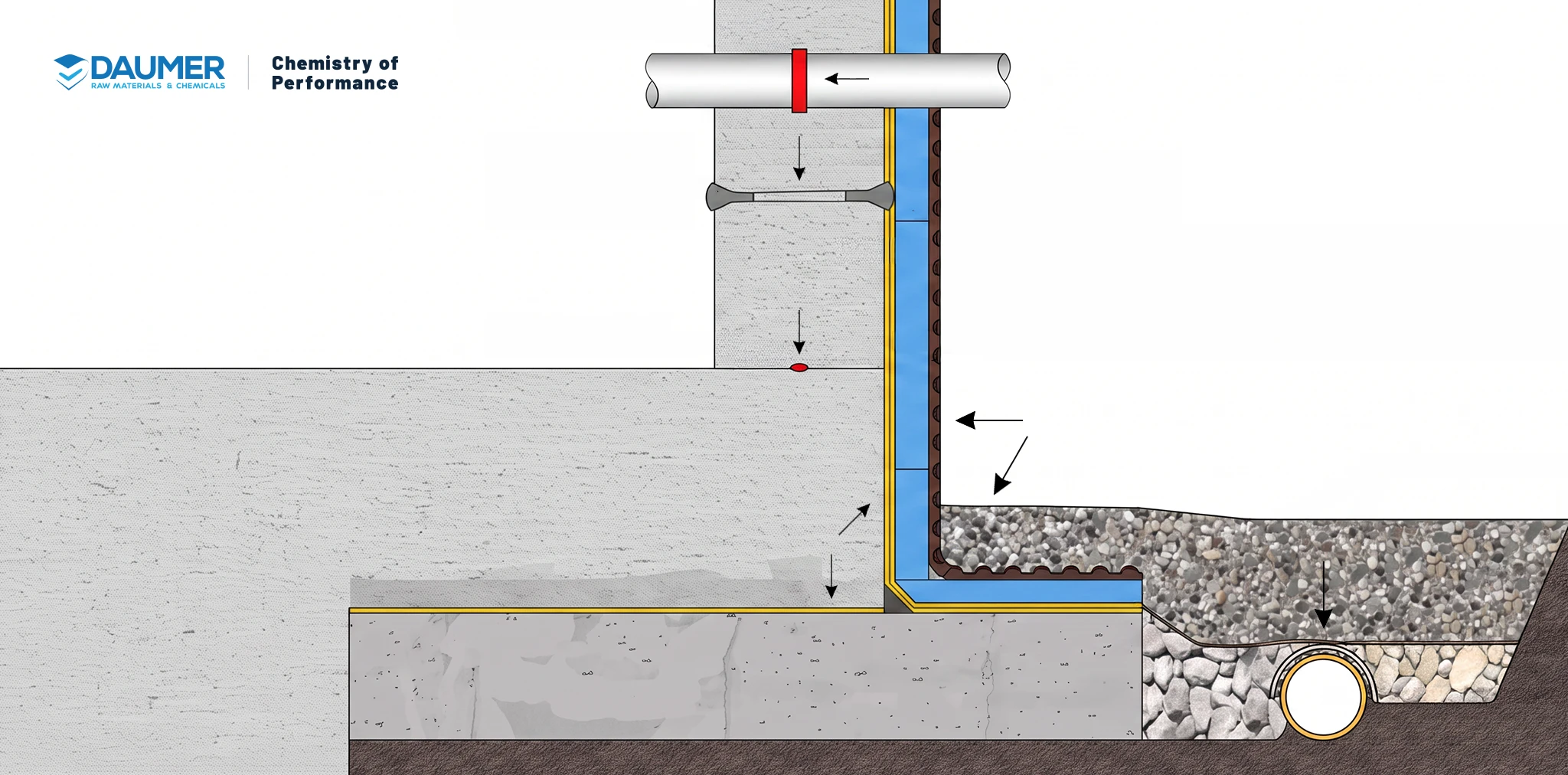
• Concrete cured and sound
• Honeycombing, tie holes and surface defects repaired with DAUFORM RPM-S or RPM-L
• Fillets formed at wall and slab junctions so the sheet is never asked to turn a sharp internal corner
• DAUGUARD BITUM PRIMER applied over the whole area and left to dry
Bituminous sheets are built on a carrier, and the carrier decides how the sheet behaves. A glass-fleece carrier is dimensionally stable and takes very little strain, which makes it the lower layer in double-layer work. A polyester carrier stretches and takes mechanical load, which makes it the upper or single layer.
The bitumen itself is modified in one of two ways. APP modification gives heat stability and suits temperate and hot conditions. SBS modification keeps the sheet flexible at low temperature, which matters when the structure is waterproofed in winter or the region is cold.
Sheets are torch-welded at the overlaps, and the overlap is where the system is made or lost.
• Every overlap inspected along its full length
• Protection board or protective screed installed before backfill
• Backfill placed in layers, without dropping material against the membrane
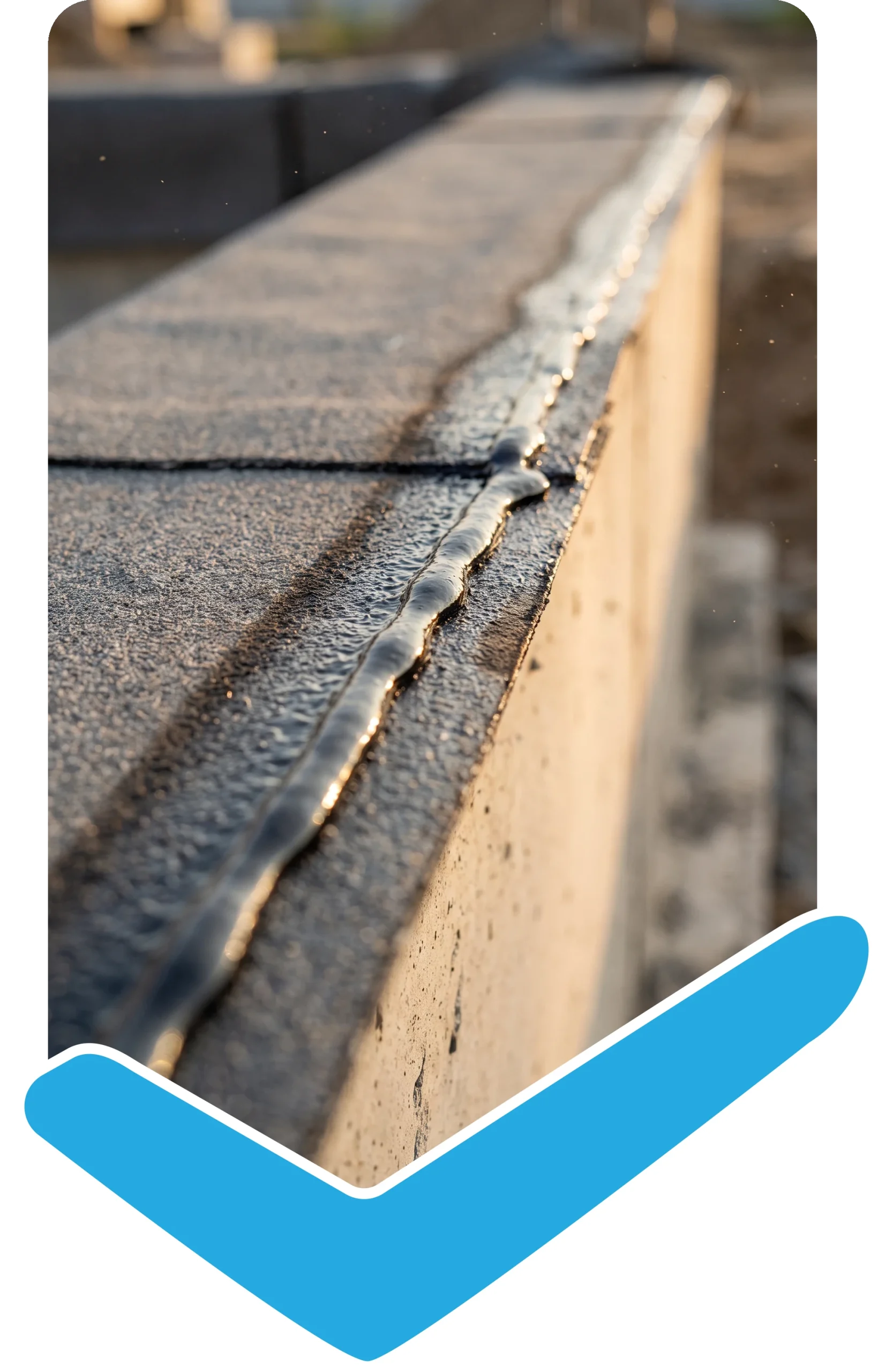
The carrier decides the behaviour, not the bitumen. Glass fleece is dimensionally stable and takes little strain; polyester takes movement and mechanical load. Double-layer work uses both, in that order. Overlaps are not less than 10 cm.
Key outcomes
• High resistance to standing water and hydrostatic pressure
• Repairable at overlaps rather than across the whole area
• Inspectable layer by layer while the work proceeds
Products
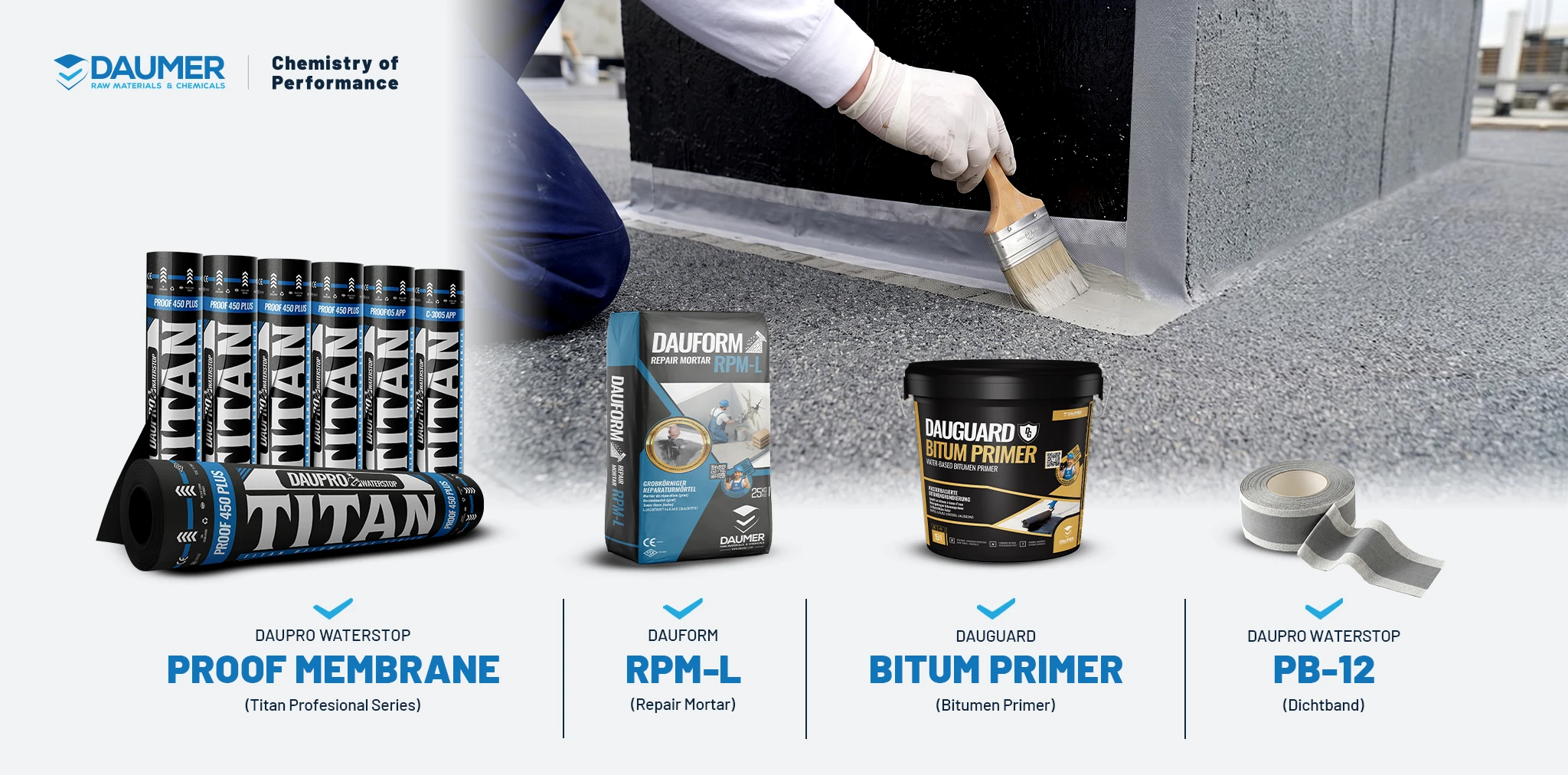
• DAUGUARD BITUM PRIMER · adhesion primer, required on all bituminous work
• Bituminous membranes, glass-fleece carrier · lower layer in double-layer build-ups
• Bituminous membranes, polyester carrier · upper or single layer, mechanical load
• APP modified · temperate and hot conditions · SBS modified · cold conditions
• DAUFORM RPM-S / RPM-L · substrate repair before waterproofing
• DAUPRO WATERSTOP PB-12 · sealing tape at difficult junctions
Joints and penetrations · Optional
– PB-12 tape at junctions the sheet cannot dress cleanly
– GB-20 PVC waterstop where a movement joint passes through the structure
When it is preferred:
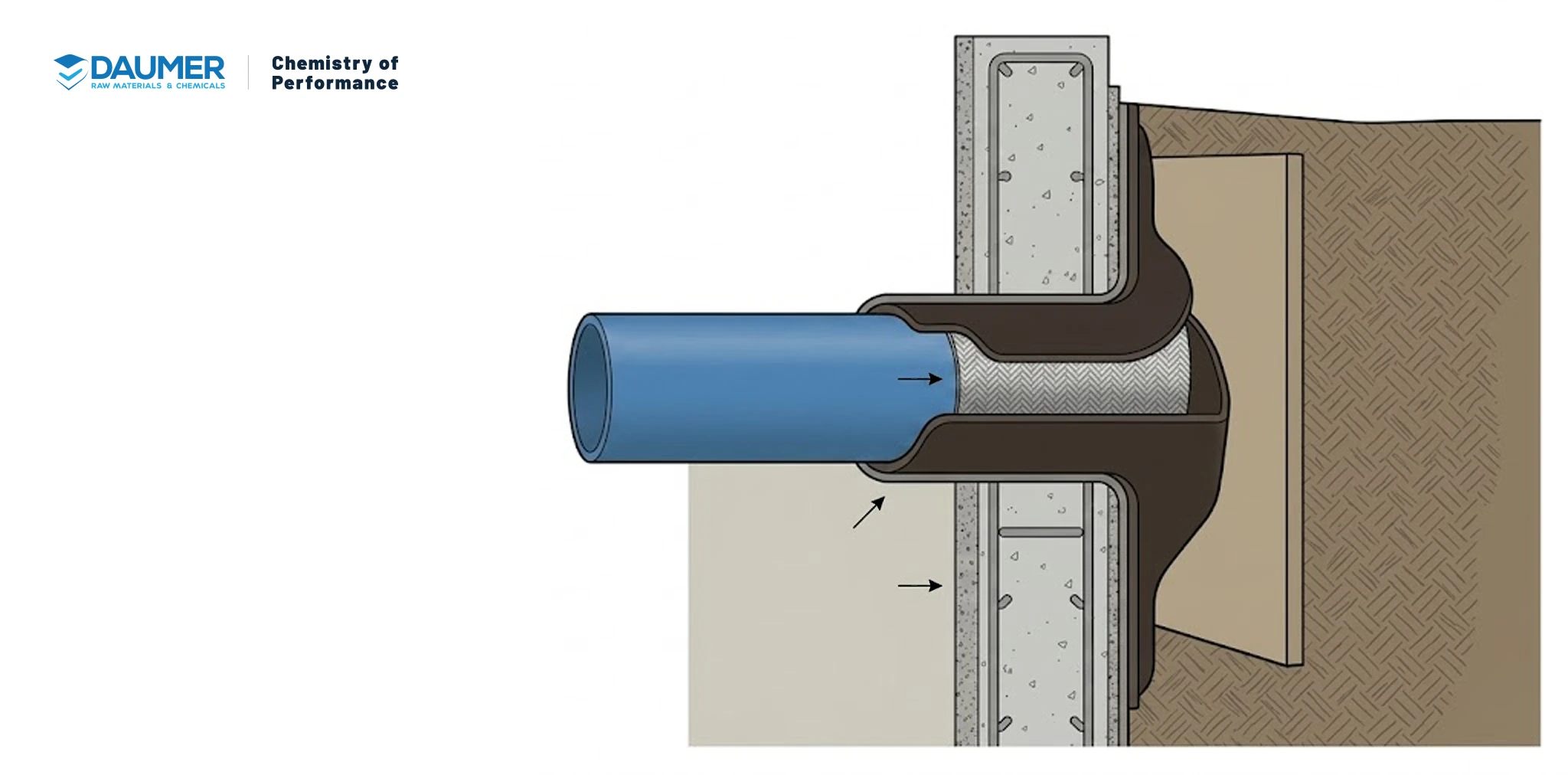
The geometry defeats a sheet. Pile caps, ring beams, stepped foundations, clustered pipe penetrations and tight working spaces all force a sheet system into cuts, patches and hand-formed corners, and every one of those is a seam. A liquid system has no seams at all.
• Substrate sound, free of laitance and loose material
• Repairs completed and cured
• DAUGUARD BITUM PRIMER on absorbent surfaces
The material is supplied ready to use and applied in coats by brush, roller or spray. It cures to a continuous flexible film that follows every corner, upstand and penetration without a single overlap.
What the system removes in seams it adds in one variable: thickness. A sheet has a known thickness because it was made in a factory; a liquid coating has the thickness the applicator gives it. This is why consumption per square metre is measured on site rather than estimated, and why the number of coats is specified rather than left to judgement.
• Full cure before any covering
• Protection board before backfill
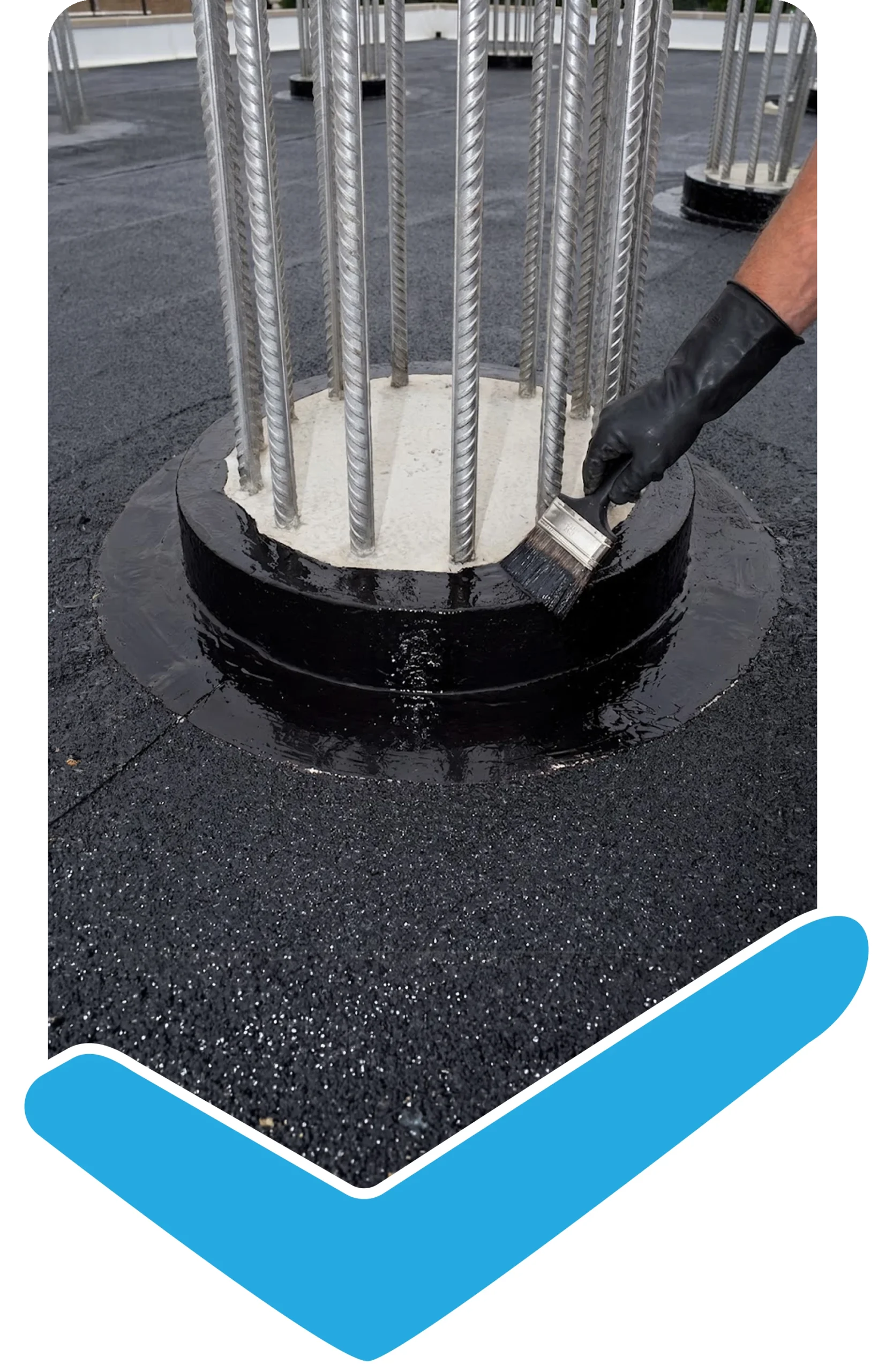
A seamless coating removes the overlap, which is where sheet systems most often fail, and replaces it with a different variable: applied thickness. Consumption per square metre is measured, not estimated.
Key outcomes
• Continuous film around geometry sheets cannot follow
• No hot work on site
• Detailing done with the same material as the field, not with patches
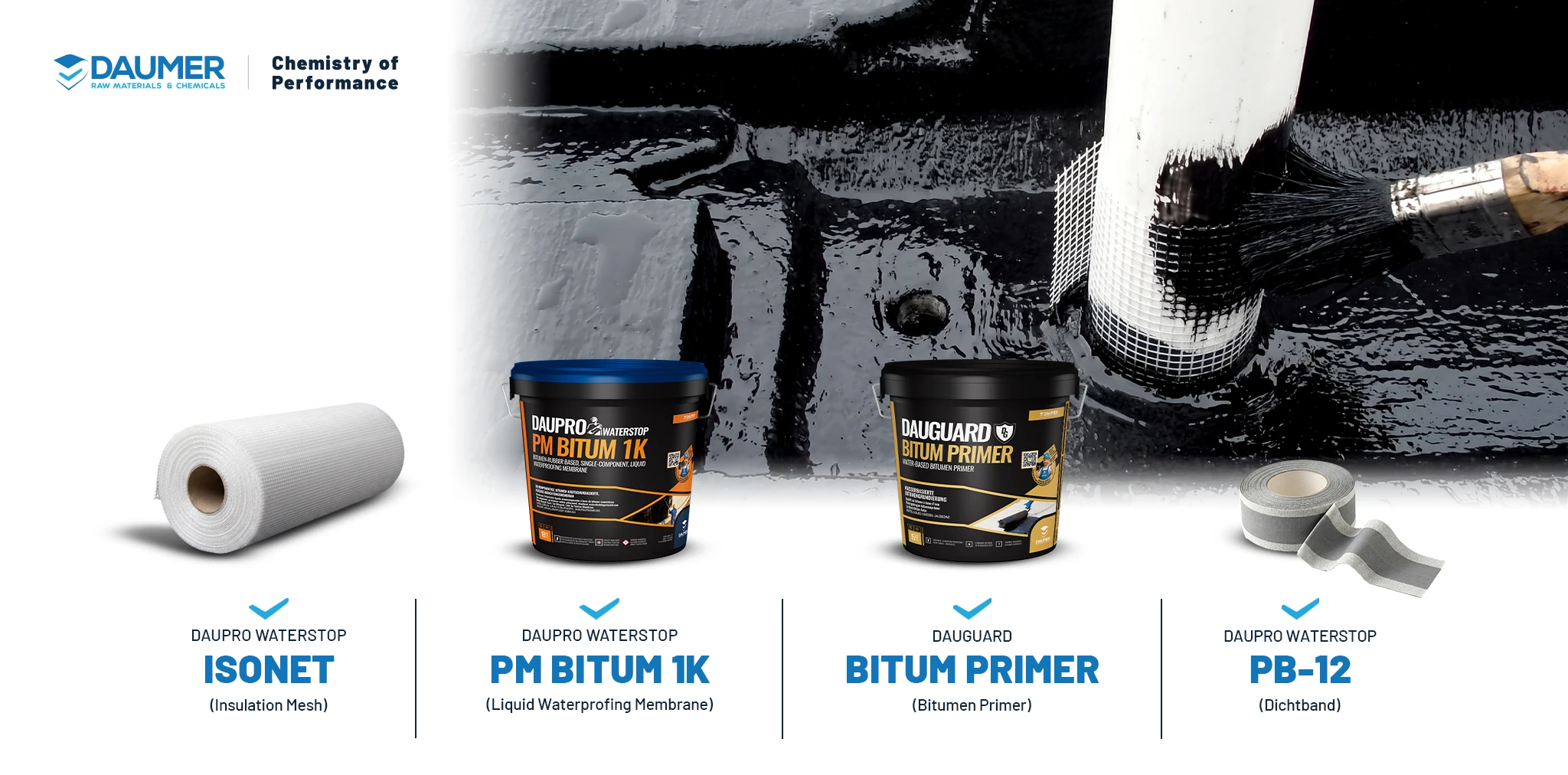
Products
• DAUGUARD BITUM PRIMER · adhesion primer on absorbent substrates
• DAUPRO WATERSTOP PM BITUM 1K · one-component liquid bituminous membrane
• DAUPRO WATERSTOP ISONET · reinforcement fleece where movement is expected
• DAUPRO WATERSTOP PB-12 · sealing tape at junctions
Joints and penetrations · Optional
– PB-12 tape at wall and slab junctions
– ISONET embedded between coats over cracks and stress points
– DB-15 to DB-40 bands across dilatation joints
• Substrate sound, damp but without standing water
• Repairs completed
• DAUGUARD BITUM PRIMER on absorbent surfaces
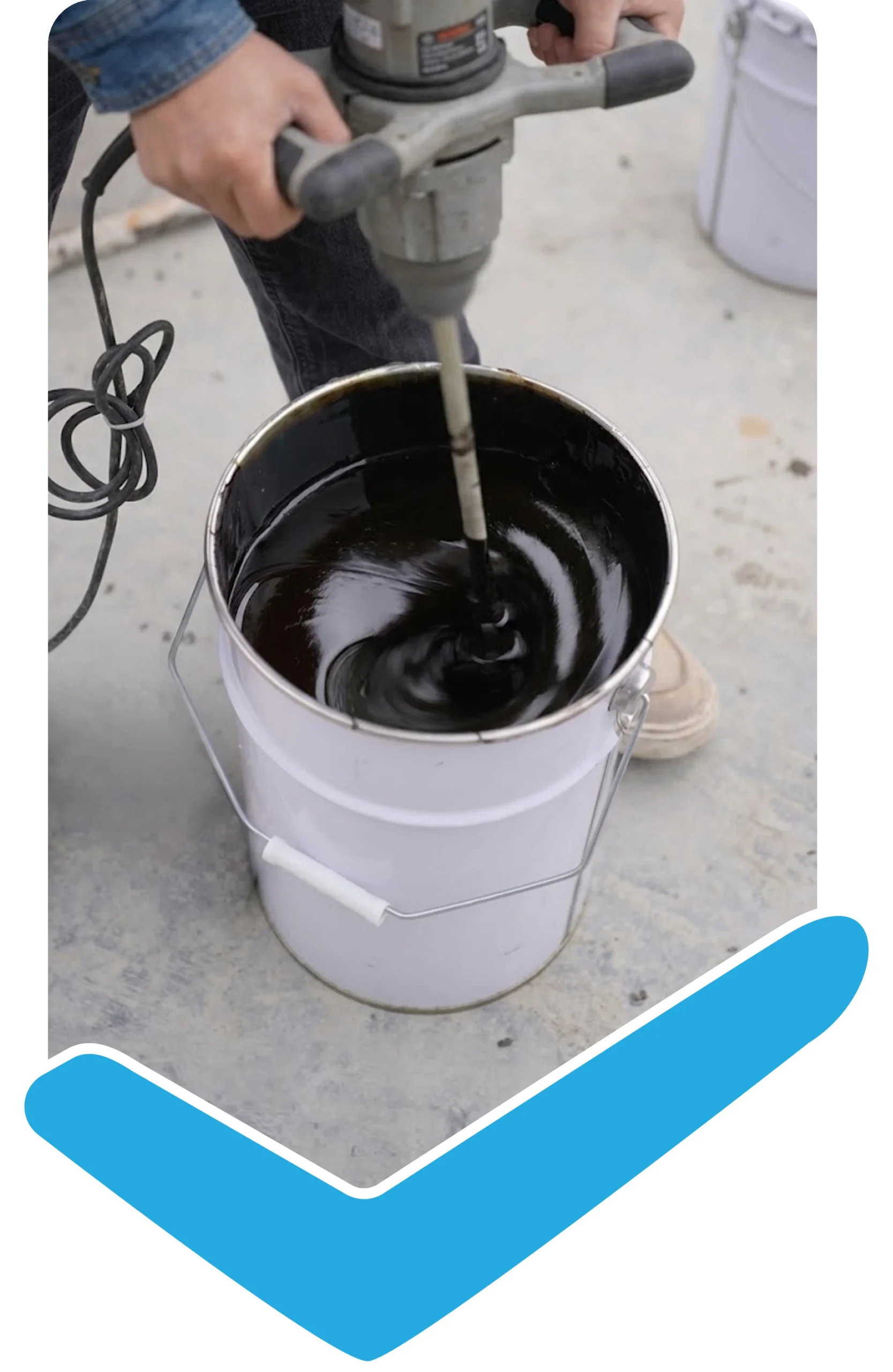
• Components mixed mechanically to a uniform consistency
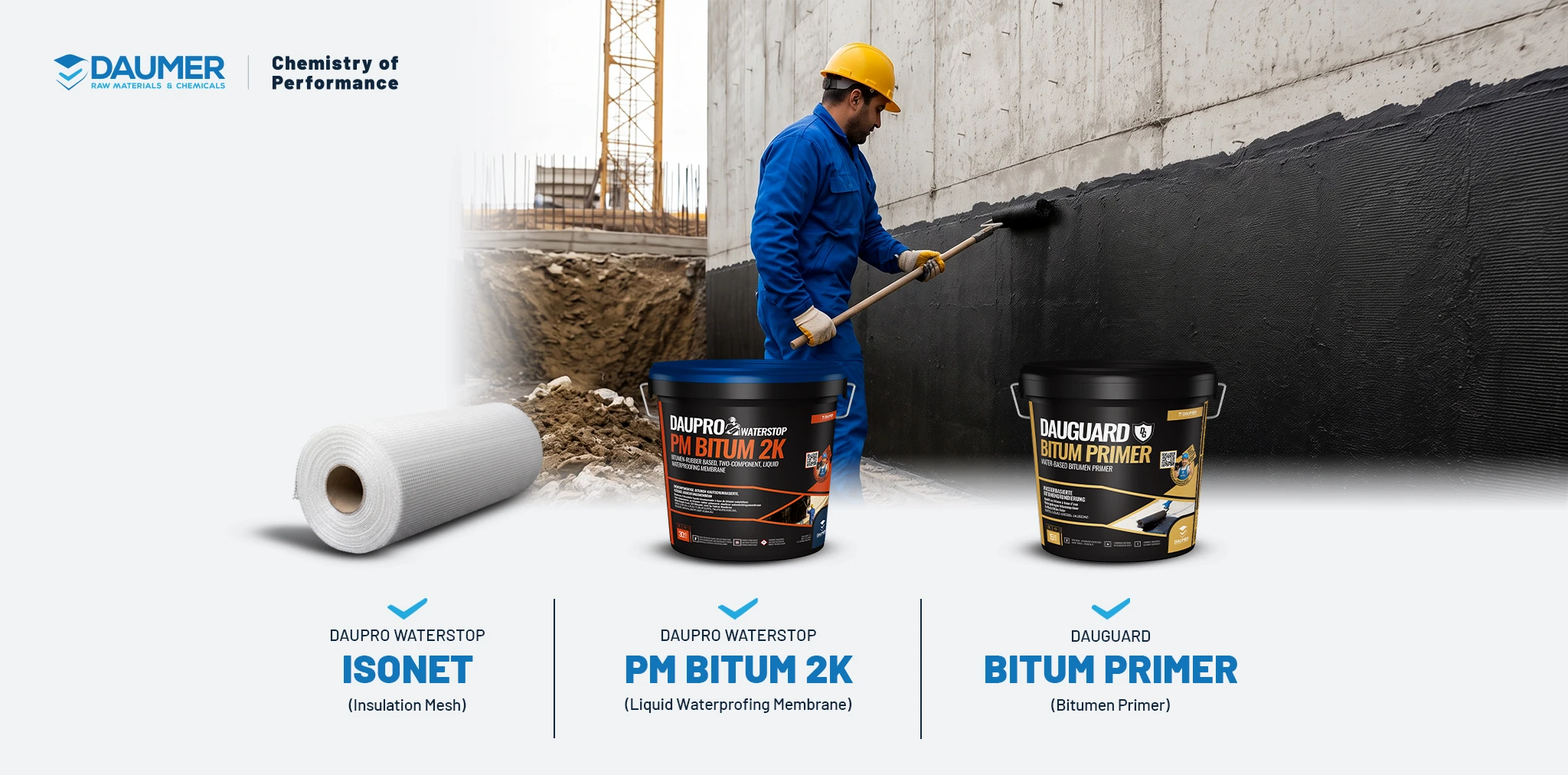
The system pairs a water-based bitumen emulsion with a mineral-filled cement powder. When the two are mixed, the cement takes up the water in the emulsion and sets, so the coating stops depending on evaporation to harden.
That single difference changes what the system can do on site. It builds thickness in fewer passes, it hardens in hours rather than days, and it tolerates a substrate that is still damp, because the cement component wants water rather than being harmed by it.
• Cure protected from rain until set
• Protection layer before backfill
• Technical note
This is the system to choose when the substrate cannot be dried and the excavation cannot stay open. The cement component sets by hydration, so damp concrete helps the coating rather than delaying it.
Key outcomes
• Application on damp concrete
• Faster turnaround on a live excavation
• Thickness built in fewer passes
Products
• DAUGUARD BITUM PRIMER · adhesion primer on absorbent substrates
• DAUPRO WATERSTOP PM BITUM 2K · two-component liquid bituminous membrane
• DAUPRO WATERSTOP ISONET · reinforcement fleece where movement is expected
• DAUPRO WATERSTOP PB-12 · sealing tape at junctions
Joints and penetrations · Optional
– PB-12 tape at junctions and penetrations
– ISONET between coats over cracks
– DB bands across dilatation joints
When it is preferred:
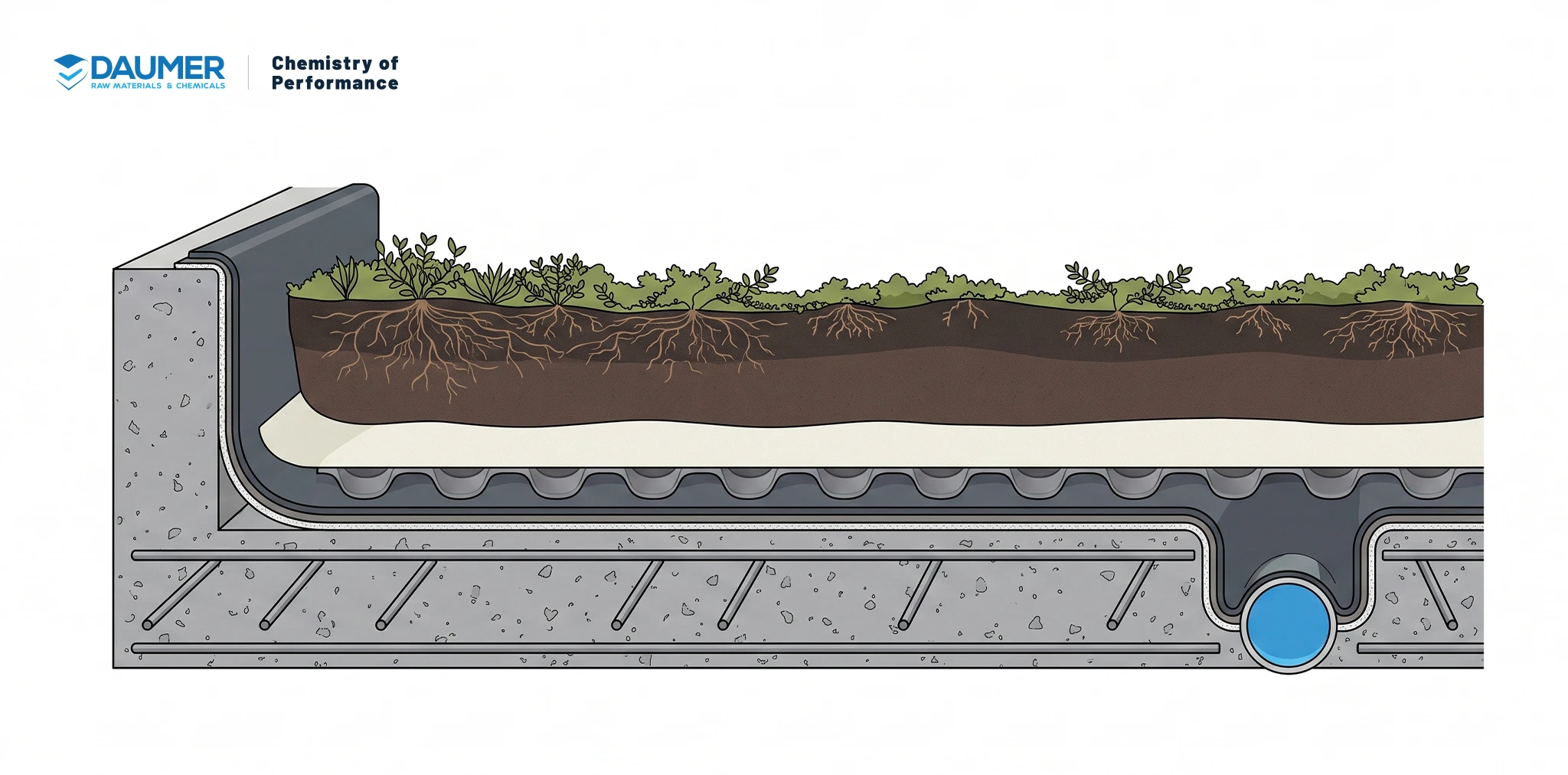
Soil and planting will sit on top of the structure. Green roofs, landscaped areas over underground car parks, podium decks and planters all put a waterproofing layer under a permanent load of wet soil and living roots, with no way to inspect or repair it once the landscape is in.
Roots are the reason this is a separate system. A root looks for water and grows towards it, and it will find a seam, a weak spot or a soft coating and pass through it over the years. The membrane here is assessed for that condition, which means the build-up does not need a separate root barrier sheet laid over it.
• Substrate sound; honeycombing and defects repaired with DAUFORM RPM-S or RPM-L
• Substrate moisture measured, not judged by appearance
• Primer chosen by that reading:
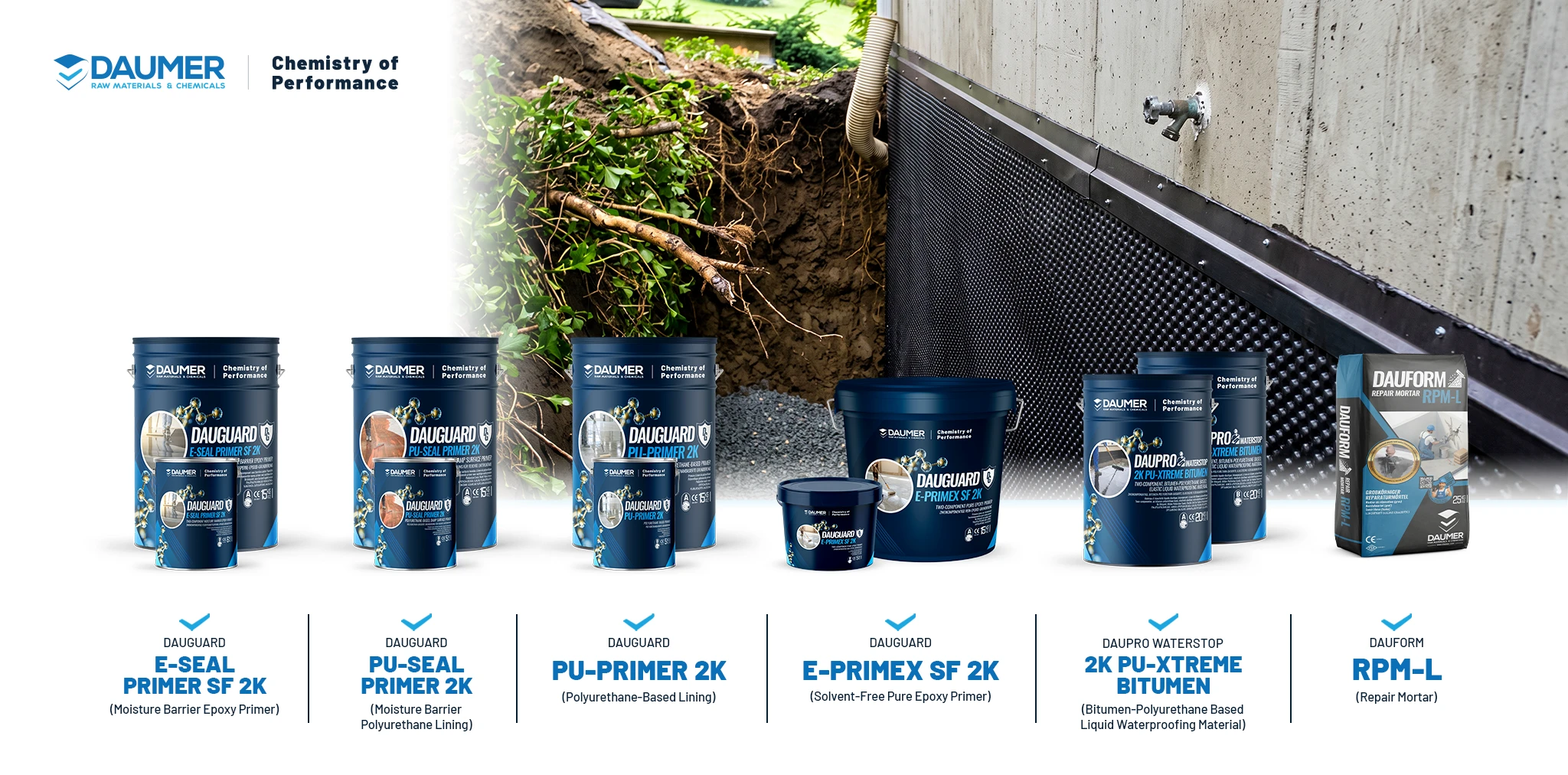
• Damp concrete or residual moisture risk · DAUGUARD PU-SEAL PRIMER 2K or DAUGUARD E-SEAL PRIMER SF, both moisture-barrier primers
• Concrete measured dry · DAUGUARD PU-PRIMER or DAUGUARD E-PRIMEX SF
• Falls and drainage outlets checked before coating; a buried deck cannot be re-graded later
DAUPRO WATERSTOP 2K PU-XTREME is a bitumen-modified polyurethane. The polyurethane gives elasticity and a seamless cure; the bitumen modification gives the film the density and resistance a buried membrane needs under permanent soil load and root contact.
It is applied as a liquid, so drains, upstands, planter edges and pipework are dressed with the same material as the flat field. There is no seam for a root to follow, and no separate root barrier to slip, tear or be punctured by the landscaping crew.
The system carries a European Technical Assessment, which is the document a specifier reads before a buried membrane is approved.
• Full cure before any load is placed
• Flood test before the landscape build-up begins
• Drainage board, filter fleece and growing medium installed without dragging or dropping material on the membrane
• Access route for the landscaping crew agreed before they arrive
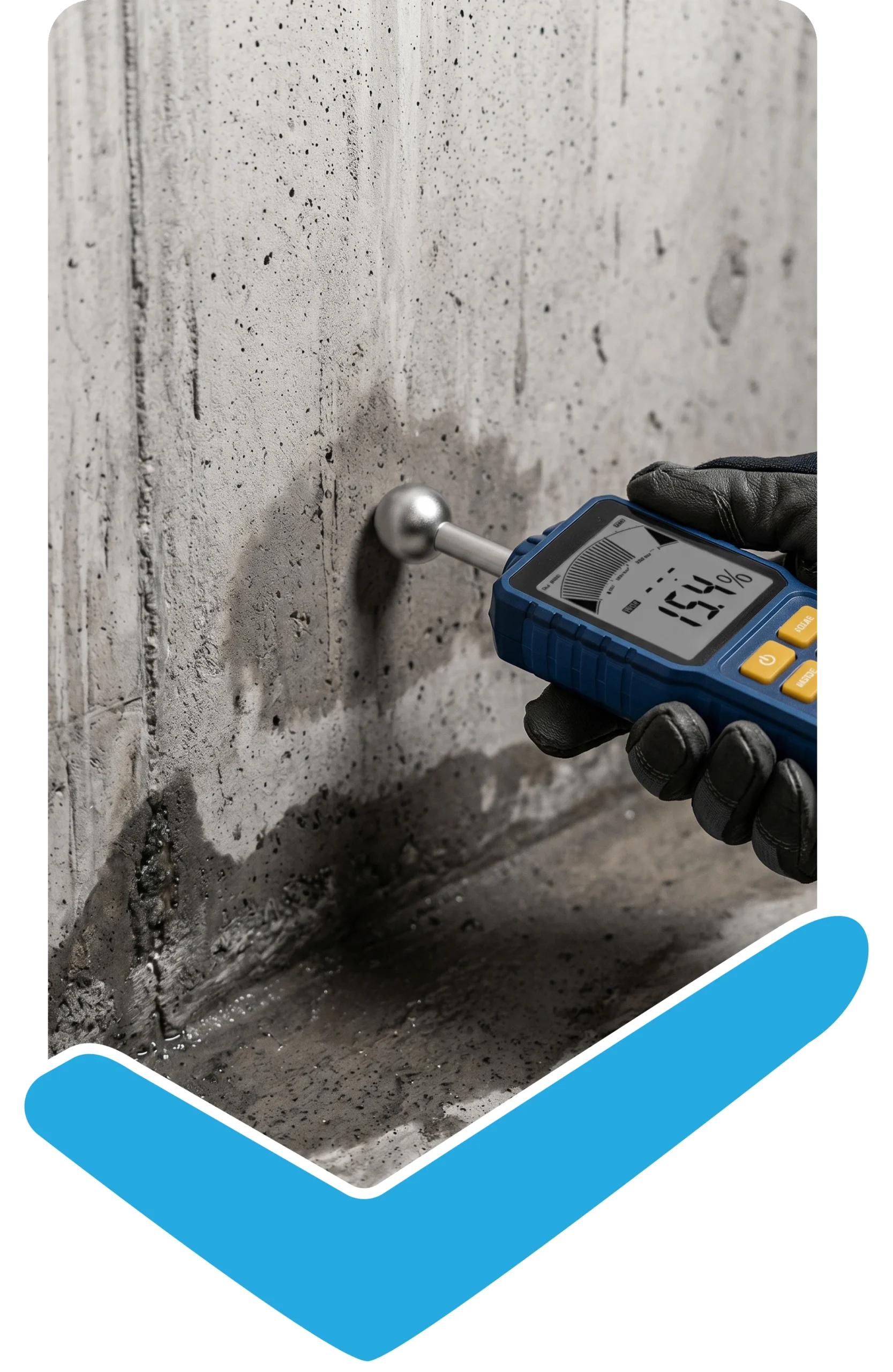
The primer decides this system. A moisture-barrier primer is used wherever residual moisture is possible, and the plain primer only where the concrete has been measured dry, which in most seasons it is not. A buried membrane cannot be inspected again, so the flood test before covering is not optional.
Key outcomes
• Root resistance without a separate barrier sheet
• Seamless around drains, upstands and planter edges
• Assessed under a European Technical Assessment for buried use
Products
• DAUGUARD PU-SEAL PRIMER 2K or E-SEAL PRIMER SF 2K · moisture-barrier primer on damp concrete
• DAUGUARD PU-PRIMER or E-PRIMEX SF 2K · primer where the concrete is measured dry
• DAUPRO WATERSTOP 2K PU-XTREME · bitumen-modified polyurethane membrane, root resistant
• DAUFORM RPM-S / RPM-L · substrate repair before priming
Joints and penetrations · Optional
– DB-15 to DB-40 bands across dilatation joints
– PB-12 tape at upstands and penetrations
When it is preferred:
The structure is permanently damp, the outer face cannot be reached, or the waterproofing has to survive being cast into concrete instead of sitting on it. This is also the system for negative-side work, where the water is on the far side of the wall and the only available surface is the inside.
• Concrete surface clean, open-pored and free of laitance
• Surface pre-wetted; the reaction needs water to travel
• For the admixture route, dosage agreed with the batching plant before the pour
• Active leaks stopped with PUR-JET before treatment begins
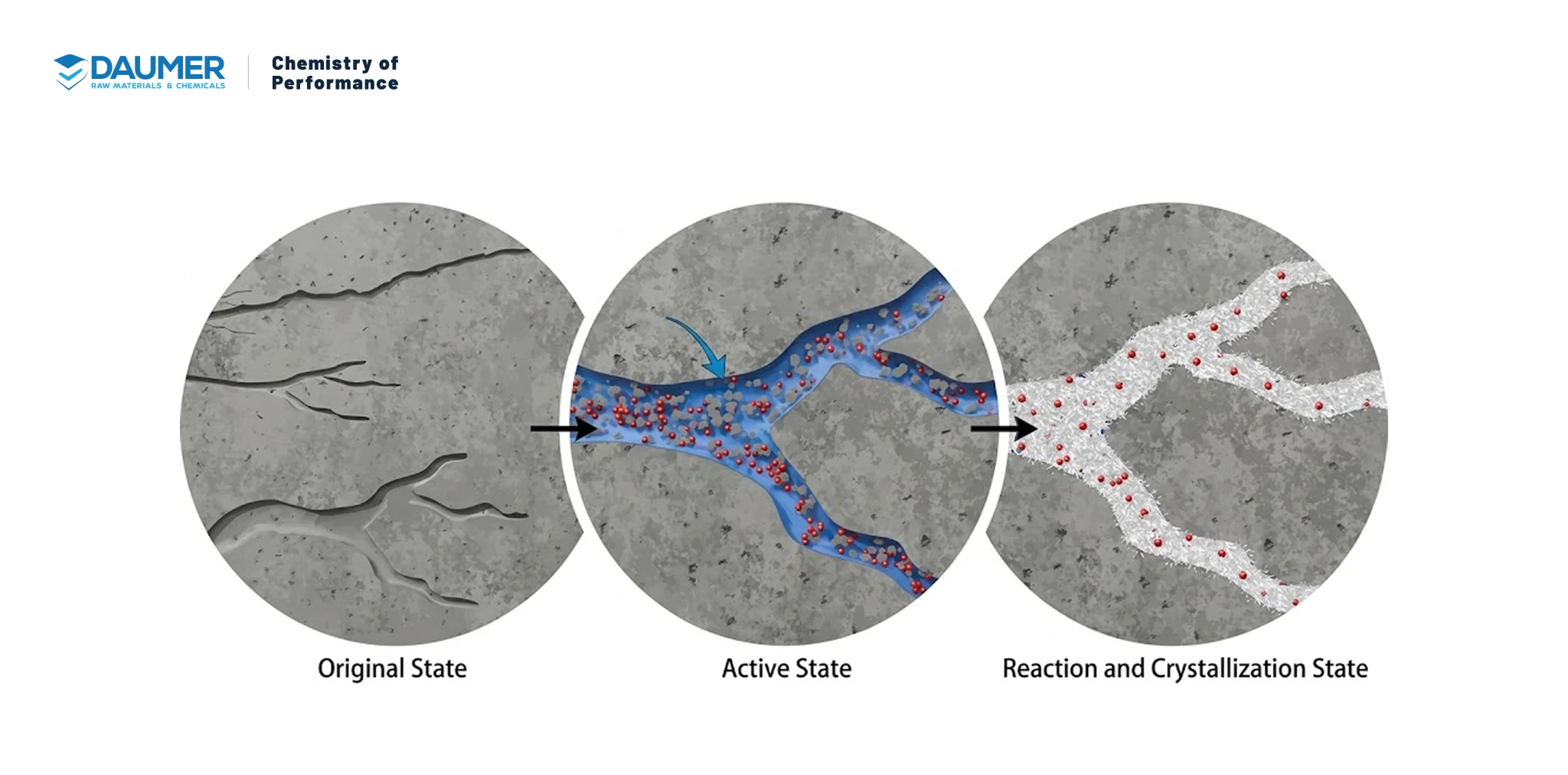
The material carries active components that dissolve in water and travel into the capillary pores of the concrete. There they react with the free lime and moisture already present and grow crystals that fill the pores, closing the paths water was using.
Two consequences follow. Because the crystals form inside the concrete rather than on its surface, there is no layer to puncture, tear or debond, and surface damage does not create a leak. And because the reaction restarts whenever water returns, a micro-crack that opens years later is closed again by the same mechanism.
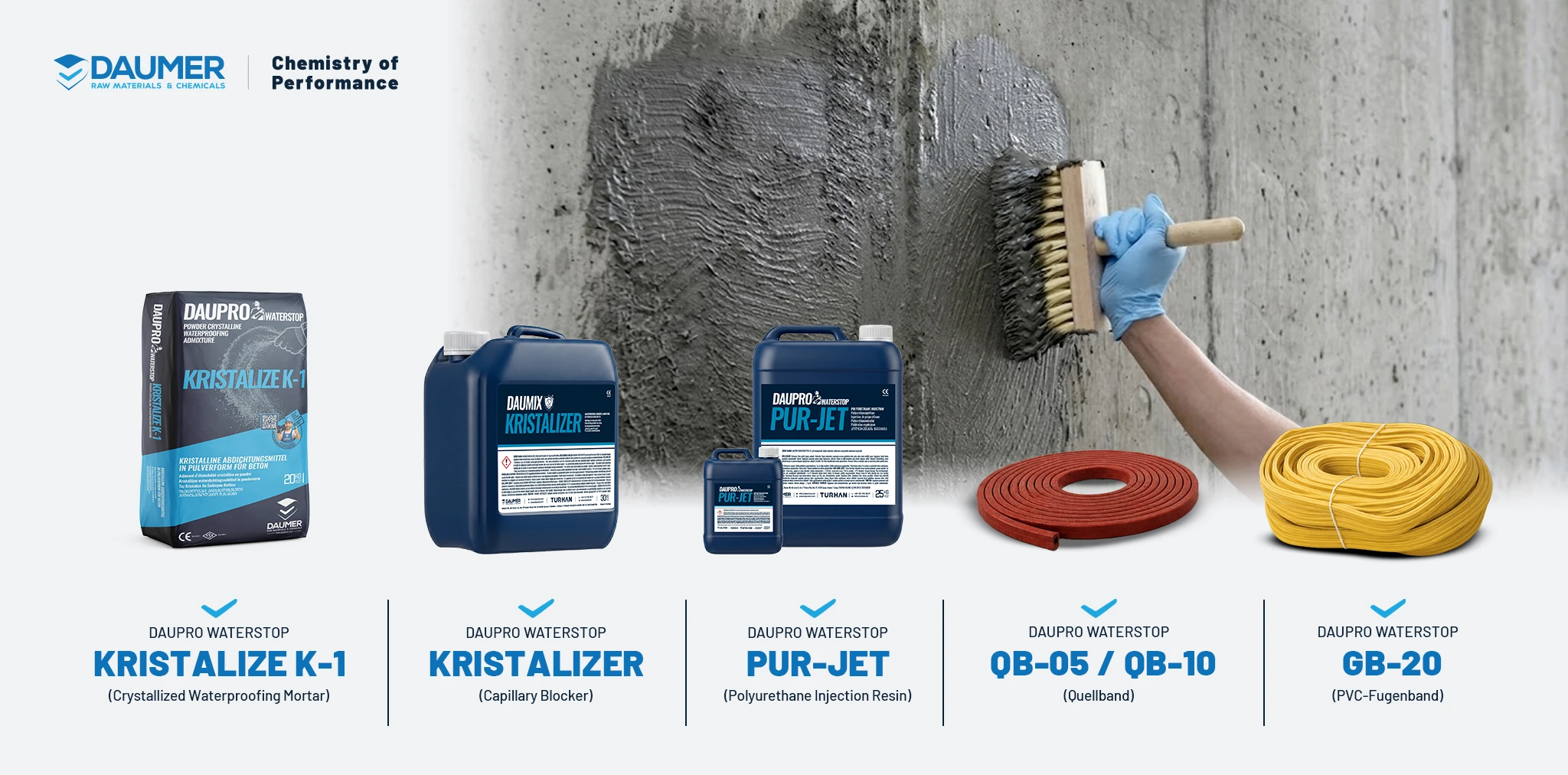
• DAUPRO WATERSTOP KRISTALIZE K-1 · surface-applied crystalline treatment
• DAUMIX KRISTALIZER · crystalline admixture dosed at the batching plant
• DAUPRO WATERSTOP PUR-JET · injection resin for active leaks before treatment
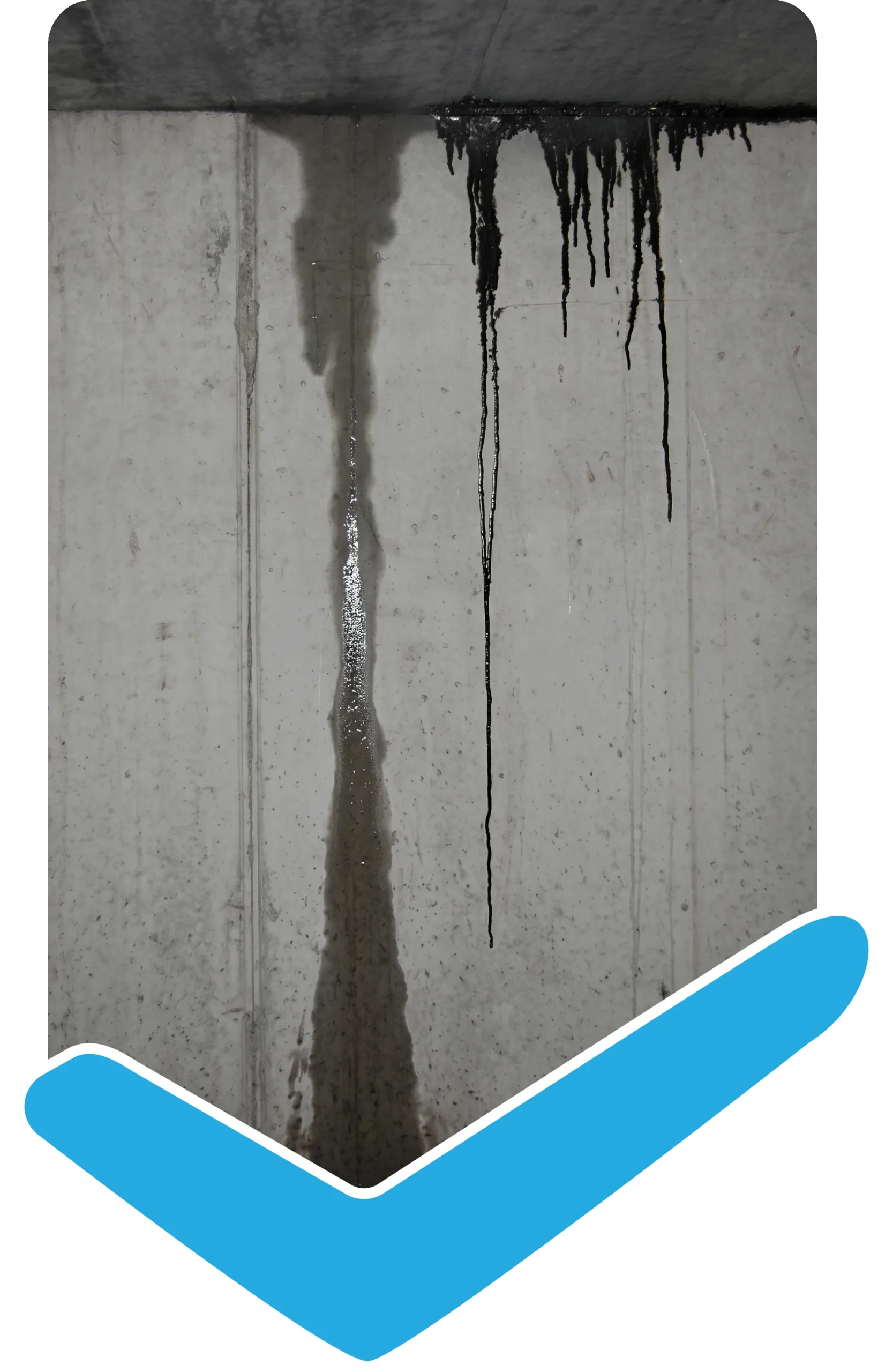
Crystalline treatment works with water rather than against it, which is why it can be applied from the negative side. It is not a substitute for a membrane where the structure moves, and it does not seal a joint. The joint elements above are part of the system, not an accessory to it.
Key outcomes
• Waterproofing inside the concrete, not on it
• Applicable from the inside face when excavation is impossible
• Unaffected by surface damage, and self-sealing against later micro-cracks
Products
• DAUPRO WATERSTOP KRISTALIZE K-1 · surface-applied crystalline treatment
• DAUMIX KRISTALIZER · crystalline admixture dosed at the batching plant
• DAUPRO WATERSTOP PUR-JET · injection resin for active leaks before treatment
Joints and penetrations · Required
– Crystalline treatment seals the concrete, not the gaps between pours. This system is incomplete without joint elements.
– QB-05 / QB-10 swelling bars along every construction joint
– GB-20 PVC waterstop in movement joints
– PB-12 at penetrations
– PUR-JET injected where water is already running through a crack
When it is preferred:
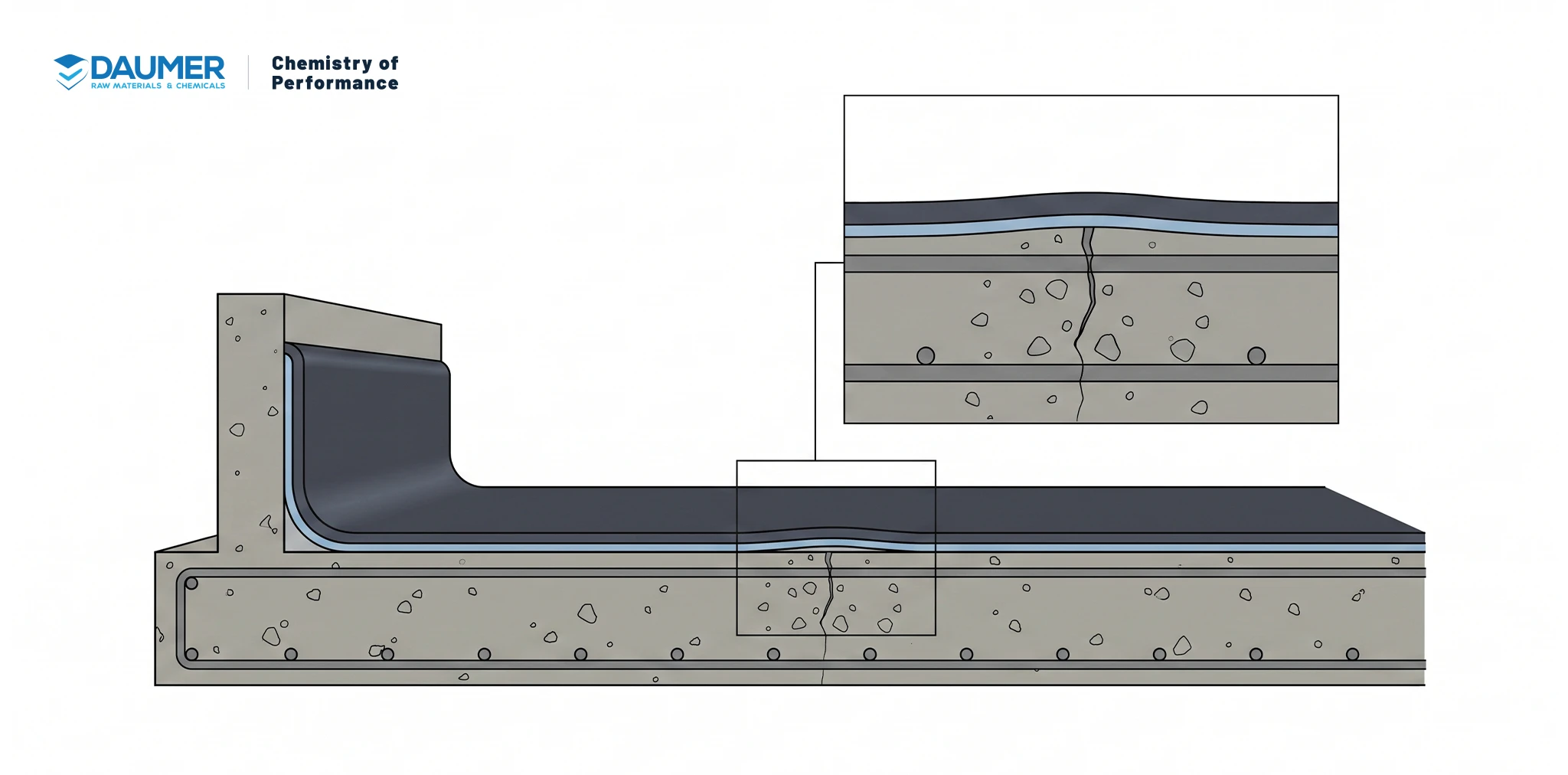
Not the usual choice below ground. It is specified where the conditions justify a higher-cost route: slabs and decks that will carry load, structures with real movement, or a programme that cannot wait. Where those conditions are absent, one of the systems above will do the same work.
• Substrate sound, dry and mechanically prepared by grinding or shot blasting
• Substrate moisture measured with an instrument, not judged by appearance
• DAUGUARD PU-SEAL PRIMER 2K or E-PRIMEX SF according to the coating and the substrate
• Primer overcoated within its stated window
Polyurethane and polyurea coatings cure by chemical reaction rather than by drying, which is why they build a seamless elastic film quickly and why they are sensitive to moisture while curing. The elasticity is the reason to choose them: they bridge cracks that open after application and keep doing it through thermal and structural movement.
Polyurea cures in seconds rather than hours, which allows a surface to be turned round in a day, and it is sprayed rather than brushed.
• Protection or wearing layer before backfill or traffic
• Full cure before loading
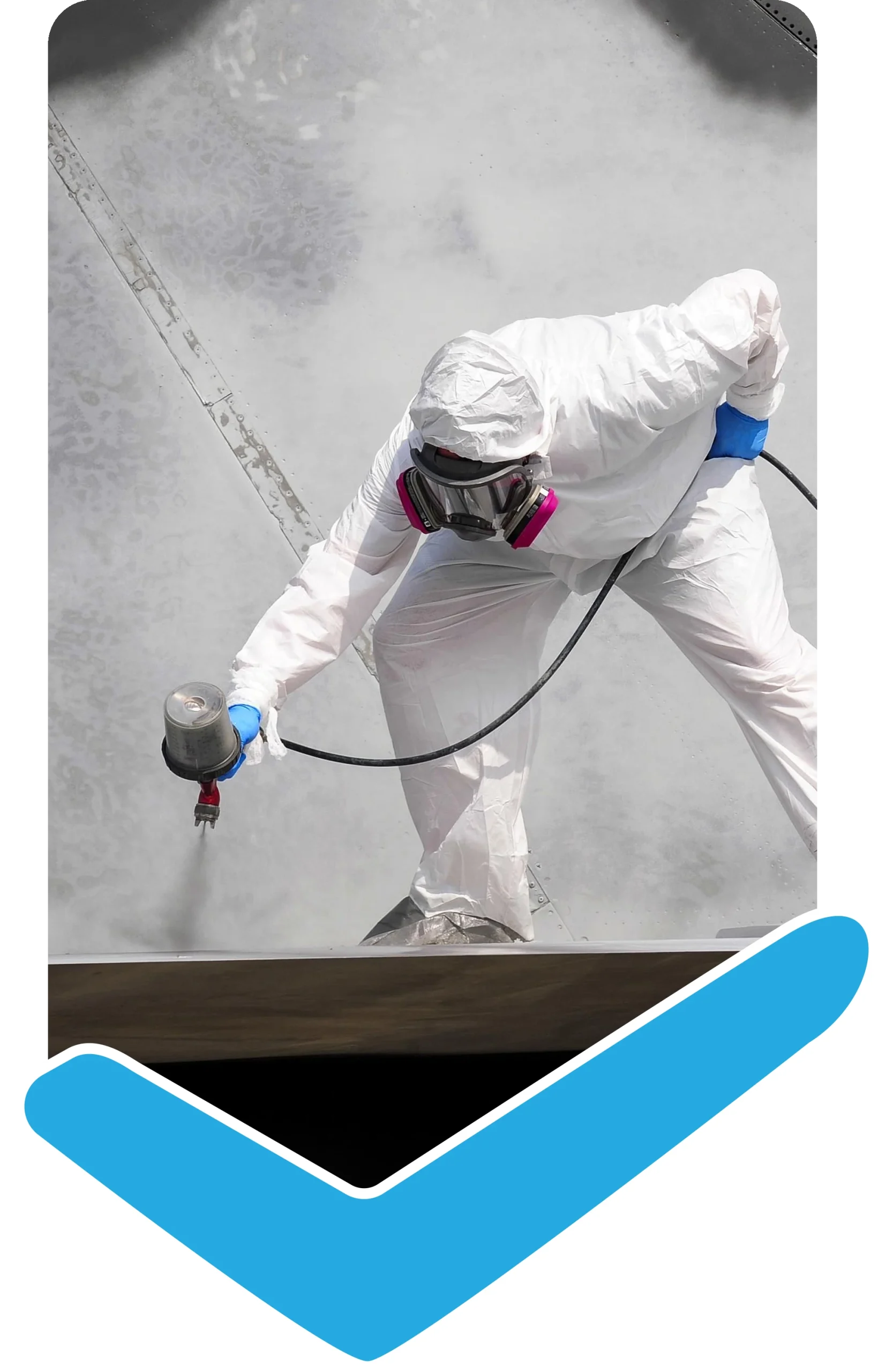
Polyurethane systems are moisture sensitive while they cure. The substrate moisture reading, not the look of the surface, decides whether application starts. Below ground the coating is never exposed to daylight, so no UV topcoat is required; that is a terrace and roof requirement, not a buried one.
Key outcomes
• Seamless and elastic, with high crack-bridging capacity
• Trafficable once protected
• The fastest route back into service where the programme demands it
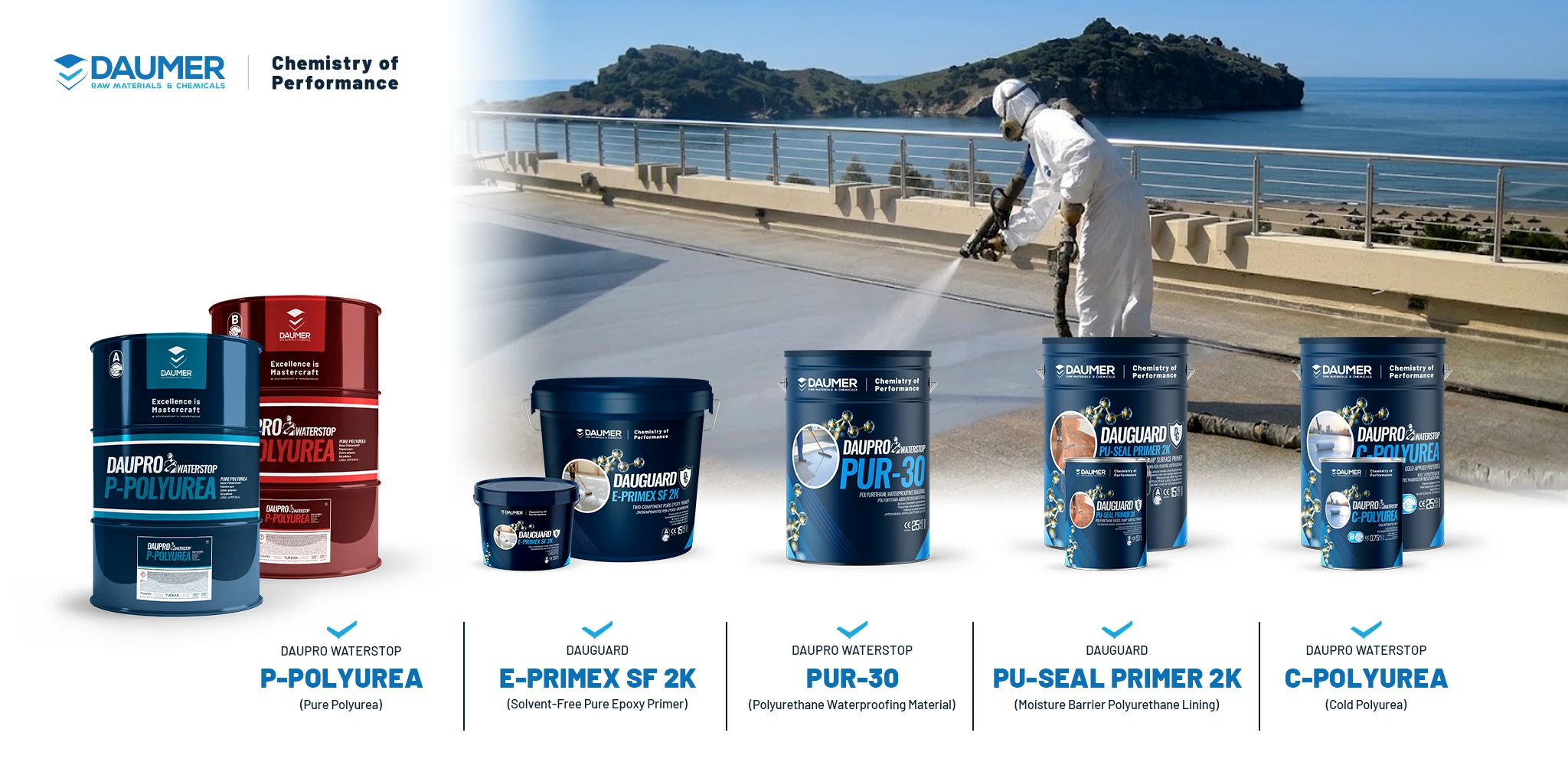
Products
• DAUGUARD PU-SEAL PRIMER 2K / E-PRIMEX SF 2K · primer by substrate and coating
• DAUPRO WATERSTOP PUR-30 · covered applications
• DAUPRO WATERSTOP P-POLYUREA / C-POLYUREA · fast turnaround, trafficked surfaces
Joints and penetrations · Optional
– DB-15 to DB-40 bands across dilatation joints
– PB-12 tape at upstands and penetrations
Tell us the structure, the water condition and the access you have, and our technical team will write the build-up for your project.